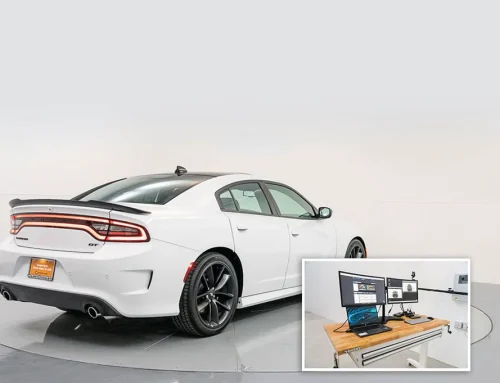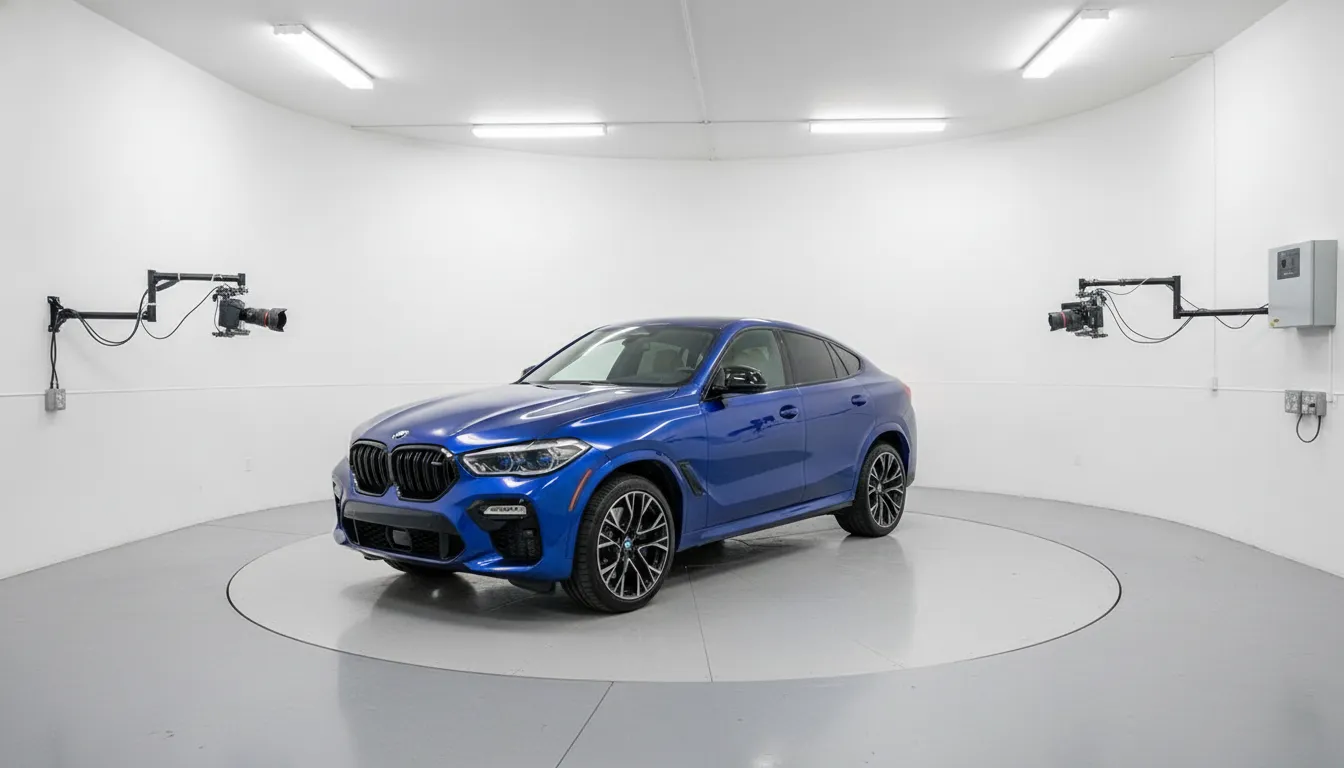
A 360 car photo booth is not a party spinner parked in the showroom. For a dealership, it is the set of parts that have to work together while one vehicle is captured: the camera, the light, the space around the car, and the person running the shot. Miss one of those and the next unit on the lot will not match the last one. This guide is the comparison list for dealer owners and general managers who are deciding what that booth has to coordinate before they buy or build.
Book a call about a 360 car photo booth
What a 360 car photo booth has to hold together
Search results for this phrase are mostly selfie booths rented for weddings. That is a different job. A dealership booth has to photograph inventory, not guests. The vehicle stays the subject, the background has to stay clean, and the same angles have to come out of every VIN the store publishes.
Four things have to agree on every car:
- The camera path. Either the camera travels around a parked vehicle, or the vehicle turns in front of cameras that stay put. Those are different machines, and they do not produce the same framing.
- The light. Paint, glass, and chrome show every hotspot. Light that is bright enough to walk around in is not the same as light that is even across a hood and a door.
- The room. A booth has walls. A truck, a van, or an open door needs more room than a compact car, and the walls decide how far the camera can stand back.
- The handoff. Exterior spin is only part of a listing. Interior and detail shots still need a person, and those frames have to match the exterior.
EZ360 builds this as separate products, not one rental package. The automated photo studio is a wall-to-wall bay. The EZTurn is the motorized table. CarMagic AI is the walkaround software. A buyer comparing a 360 car photo booth should keep those three apart, because a booth quote, a table quote, and a software plan answer different problems.
Camera path: riding the booth or fixed on the wall
This is the first split. In a push-style booth, the vehicle sits still and the camera is mounted on a frame that someone walks or pushes around it. In a studio with a turntable, the cameras stay on the wall and the vehicle rotates. Both can produce a spin. They do not fail the same way.
When the camera rides the booth, every lap depends on the person pushing. Speed changes. The frame can tilt if the track is uneven or the booth bumps. Two operators on the same vehicle can hand the website two different spins. When the cameras are fixed and the table speed is set by the controller, the lap matches on the first vehicle and the fortieth.
Ask which path the quote uses, and how many cameras it includes. On the EZ360 photo studio page, the studio is described with wall-mounted cameras for the exterior spin plus separate cameras for the interior panorama and the detail shots. A single camera on a moving ring covers one height. A second fixed camera can catch a higher or lower angle in the same revolution, which matters on tall trucks.
Also ask what happens after the shutter. A booth that only drops files on a laptop still needs someone to crop, name, and push them into the dealer site. A studio tied to a production computer can send the spin out as the car is shot. That publishing step is part of the booth, not a later project.
Light that does not travel with the camera
Event booths often rely on whatever the room already has, plus a ring light near the lens. Vehicle paint does not forgive that. A roof rail, a black hood, and a windshield each need light from more than one direction, or the listing shows a bright stripe and a dead panel.
The useful test is simple. Shoot the same dark vehicle twice, once with the lights you already have and once with the booth lights the vendor is selling. Look at the hood, the side glass, and the wheel openings. If the bright spots move when the car moves, the light is not diffuse enough for a full spin.
EZ360 treats light as the main reason a dealer builds a bay instead of shooting the parking lot. The studio page says the three factors that decide picture quality are light, light, and light, because sun, rain, and snow do not wait for the photo queue. The how the photo studio works page describes 300,000-lumen stadium LED lighting meant to be soft and diffuse so hotspots and hard shadows drop out. Treat that lumen figure as EZ360’s description of its own studio, not as a number every booth should print on a spec sheet.
Safety lighting is a separate question from photo lighting. California’s general-industry illumination order, Title 8, section 3317, sets minimum foot-candles so people can work safely in shops, warehouses, and spray booths. Those minimums keep a bay from being dark. They do not tell you whether a black vehicle will photograph cleanly. A booth can pass a workplace lighting check and still fail a paint-color check.
Space, vehicle size, and what the walls block
A round booth has a fixed diameter. That diameter is the entire studio. If the walls are close, the camera is close, and wide vehicles crop at the mirrors. Open doors for a second spin need still more room. A turntable in an open bay can use whatever footprint the building actually has, which is why dealers with trucks and vans often outgrow an enclosure before they outgrow the camera.
Compare the booth against the inventory you actually shoot, not against a sedan in the brochure.
| What to measure. | What a tight booth does. | What an open bay lets you change. |
|---|---|---|
| Widest vehicle, mirrors out. | Fixed walls decide the crop. | Camera distance can move with the vehicle. |
| Open-door spin. | Often skipped when the door hits the frame. | Second spin with doors open is a normal pass. |
| Ceiling height. | Tall vans and light bars hit the ring. | Lighting can be planned for the roof you have. |
| Wash and detail nearby. | The enclosure is photo-only. | A larger bay can include a wash or detail station. |
EZ360 says its studios are designed to the room, and that it has fitted bays in rooms as small as 24 by 27 feet. That figure is an example of a small install, not a minimum you should treat as a code requirement. The same page says EZ360 can augment a booth a dealer already owns, or let the dealer’s own contractor finish walls and floor. If you already have an enclosure, the comparison is what to keep and what to replace, not a forced full rebuild.
The steps a booth does not do for you
Automation is easy to over-read. A motor can turn the car. Software can crop, center, and publish. Neither one walks into the cabin.
On a complete EZ360 production, a person still shoots the interior panorama and the detail photos. The exterior spin can start from a button. The interior cannot, because the camera has to be inside the car, and the doors, seats, and dash have to be staged first. Plan labor for that handoff even if the booth quote says the spin is automatic.
The same person, often a detailer rather than a hired photographer, also has to prep the car before it enters the bay: plates, floor mats, door handles, and a clean windshield. A booth does not fix a dirty vehicle. It photographs it evenly, which makes the dirt easier to see.
If the rooftop has no room for any bay, the alternative on the EZ360 site is not a smaller selfie booth. It is CarMagic AI walkaround software, shot outside, with background replacement. That path avoids the enclosure. It also depends on the weather and on the operator holding a steady circle. The homepage lists that software on its own card, separate from the studio. Do not fold a software plan into a booth price.
How to compare quotes without mixing products
Put every proposal on the same five lines before you talk price. Vendors use “360,” “booth,” and “studio” for different boxes.
- Camera path. Does the camera move around a still car, or does the car turn in front of fixed cameras? How many cameras, and which shots are still manual?
- Light. Is the lighting diffuse and fixed, or is it a single source that rides with the lens? Ask for a dark-vehicle sample from a real bay, not a render.
- Footprint. What vehicles fit with doors open? What ceiling do you need? Can your contractor finish the walls, or is the shell included?
- Publishing. Do files land on a desk, or do they go to the dealer website when the shot is taken?
- What is a separate SKU. Table, cameras, software, and player are not one subscription. The EZTurn page is the table. The studio page is the bay. CarMagic is the software.
The July 2023 post on an automated car photo booth already walks through why a controlled turntable beats a push booth on consistency and automation. Use that page for the head-to-head. Use this one to decide which pieces your quote actually includes.
Sync is the part a spec sheet skips
A booth quote can list a camera, a ring, and a set of lights and still leave them as three separate purchases. The listing only looks consistent when those pieces fire together. That is the coordination job.
Start with the vehicle, not the gear. It has to be centered before anything moves. On a turntable, centering means the same amount of table on every side so the crop does not drift as the vehicle rotates. On a booth that travels around a parked vehicle, centering means the ring stays the same distance from the rocker panel the whole way around. A vehicle that sits off center shows up as a spin that leans.
Then lock the pose. Doors, mirrors, and the steering wheel should stay in the position you want for the whole lap. A door that opens halfway through, or a mirror that gets folded between cars, breaks the set. EZ360’s studio workflow uses a second pass with the doors open rather than mixing closed and open frames in one spin. That second pass only works if the first pass finished clean.
The cameras and the motion have to share a start. If the table or the booth begins moving before the camera is recording, the first frames are empty or blurred. If the camera keeps shooting after the motion stops, you get a stack of identical frames at the end. Fixed cameras on a controlled table avoid the push-speed problem. They still need the controller and the cameras on the same cue. The studio page describes that as one-click operation. The turn starts and the cameras capture together, then the files upload.
Light is the next cue. Lights aimed for a sedan will hot-spot a tall hood if nobody resets them. A group with several rooftops feels this first. One store leaves the lights where the installer set them. Another bumps a stand while the bay is washed. The two stores then publish spins that do not look like the same brand. Write down the light positions the way you write down the camera height, and check them when the bay is cleaned.
The last cue is the handoff to the interior. The exterior spin can be automatic. The interior panorama cannot. If the operator shoots the interior under different light, or crops it in a different shape, the vehicle page looks like two cars. Decide the order before the first VIN. Exterior with doors closed, exterior with doors open, interior panorama, then the detail frames of wheels, dash, and badges. The same order on every car is what makes a group standard.
None of this says one booth is the only way to shoot a car. It asks the buyer to see which of these cues the quote actually controls, and which ones stay with the person on the floor. That is the comparison worth making before the deposit.
The homepage advertises a studio starting price and a separate 18-foot EZTurn price. Those figures are advertised starting points, not an installed quote for your building. Older lease and per-VIN offers elsewhere on the site are not the current card. A modeled per-VIN savings line is a seller illustration, not a fee. Get a written quote before you treat any public number as the project cost.
Request a quote for your photo bay
FAQ
Is a 360 car photo booth the same as a selfie booth?
No. A selfie booth photographs people at an event. A dealership booth has to photograph vehicles the same way every time, with light and framing that hold up on a vehicle detail page. The two products share a name and almost nothing else.
Can one camera on a moving ring replace a studio?
It can make an exterior spin of a car that fits inside the ring. It does not light the paint evenly, it does not shoot the interior, and the speed of the spin changes with the person pushing. Dealers who need the same look on every rooftop usually end up comparing fixed cameras and a controlled platform.
Does the booth photograph the inside of the car?
Not by itself. On an EZ360 studio, the operator still captures the interior panorama and the detail photos. Budget that labor even when the exterior spin is a button press.
What if we already own a booth?
EZ360 says it can augment an existing booth or turntable, and that a dealer can use their own contractor for walls or floor. Bring the current enclosure measurements to the call so the conversation starts from what you have.
Who should call?
Dealer owners, general managers, and group operators who are comparing vehicle photo equipment. EZ360 sells to dealerships and dealer groups in the United States and Canada, not to consumers shopping for a party booth.